


变形金刚1
长城快评丨“野人哥”冲线时停步唱国歌 太有“排面”了_我的网站

一 | 长城网·冀云客户端特约评论员 金宇8月15日,张家口第七届海坨山50公里越野赛现场,发生了感人一幕。
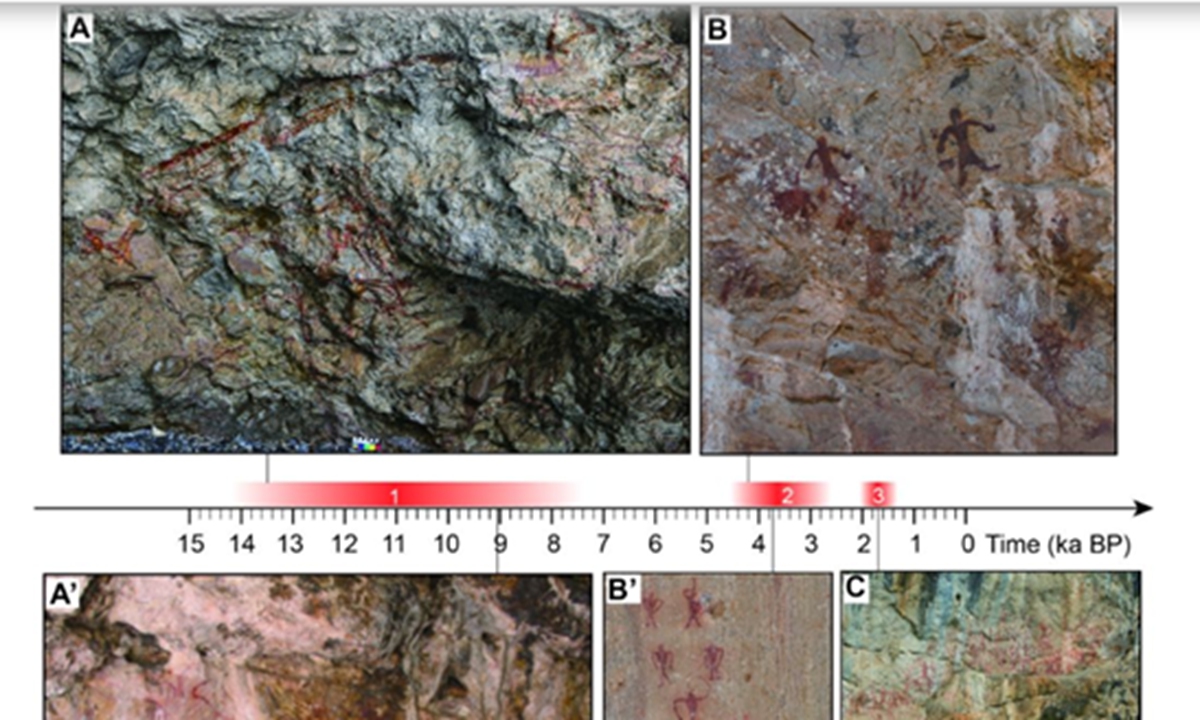
Chinese researchers have obtained the first absolute dates for rock paintings at the Mangguan rock art site in Southwest China's Yunnan Province, pushing the known history of rock art created by prehistoric settled communities in the region back to about 4,220 years ago. The paintings also suggest cultural interactions more than 4,000 years ago between Southwest China and civilizations along the Yellow and Yangtze rivers, as well as possible exchanges with neighboring parts of Southeast Asia, including present-day Myanmar, Thailand and Vietnam, a member of the research team told the Global Times.
The Yunnan Provincial Institute of Cultural Relics and Archaeology, in collaboration with Nanjing Normal University and other institutions, have recently made a significant archaeological breakthrough. Through systematic surveys and uranium-thorium (U-Th) dating at the Mangguan site in Gengma county, the research team obtained the first absolute dates for the site's rock paintings, tracing rock art created by prehistoric settled communities back to around 4,220 years ago.
The findings were recently published in the international journal Journal of Archaeological Science: Reports.
The Mangguan rock paintings represent one of the best-preserved prehistoric rock art sites in Yunnan. The research team presented high precision U Th dating of carbonate accretions that stratigraphically overlie the painted motifs at the Mangguan site, according to the paper published in the journal.
The dating results show that carbonate deposits overlying a human figure yielded a corrected age of 4,240 ± 19 years before present, confirming that ancient people living in the region had already produced mature figurative art at least 4,220 years ago, Wu Yun, first author of the paper and an associate researcher at the Yunnan Provincial Institute of Cultural Relics and Archaeology, was cited by the Xinhua News Agency report as saying.
Dating results from 11 samples taken from different motifs clustered between about 3,907 and 3,056 years ago. By comparison, the Cangyuan cliff paintings had previously been dated to roughly 3,800 to 2,700 years ago. The Mangguan paintings are therefore significantly older, filling an important chronological gap in the region's artistic record before the Cangyuan phase.
Shao Qingfeng, corresponding author of the paper and a professor at the School of Geography at Nanjing Normal University, told the Global Times that previous estimates dated the Mangguan rock paintings to a little over 3,000 years ago based mainly on imagery and comparisons with similar regional sites. Using microsamples of secondary carbonate deposits overlying the paintings, researchers have now obtained a precise minimum age of about 4,220 years before present without damaging the rock art.
The findings and the establishment of this chronological framework not only strengthen the archaeological foundation for studying rock art in Southwest China, but also provide a direct reference for rock art sites across Southeast Asia that have yet to undergo systematic dating, Shao said.
The findings may also challenge long-held perceptions of Southwest China around 4,200 years ago - roughly the era of the Xia Dynasty (c.2070 BC-C.1600 BC) - and help fill a key gap in understanding the pluralistic yet integrated development of Chinese civilization.
Shao said that while academic research has traditionally focused on the Yellow River and Yangtze River basins as cradles of early Chinese civilization, sites such as Mangguan and Cangyuan show that stable and culturally active communities also thrived in mountainous Southwest China. The newly established rock-art chronology brings an artistic dimension to the broader narrative of China's enduring cultural development.
Moreover, stylistic similarities suggest that Southwest China maintained exchanges with the Yellow River and Yangtze River regions and with early societies in Southeast Asia, providing material evidence of cross-regional interaction more than 4,000 years ago.
。

二 | 选手朱勇历经10小时30分艰难完赛,就在他即将冲线的关键时刻,现场突然响起嘹亮的国歌前奏。朱勇立刻停下冲刺脚步,驻足肃立高唱国歌,紧随其后的对手看到,也主动停下脚步,一同肃立唱响国歌。直到国歌完整奏唱完毕,两人才并肩携手跨过终点线。这个场景被拍成短视频发布后,在社交媒体和朋友圈迅速刷屏。有意思的是,大家一开始以为视频中的两位是越野比赛的冠亚军,甚至出现了“冠亚军到终点遇国歌放弃冲线”的说法。然而真实情况是,他们都是300名开外的选手。不过,这丝毫不影响广大网友为他们点赞,尽管没有名列前茅,但两位依然坚持向终点奔跑,一点也没有放弃的意思。尤其是朱勇,跑得浑身是汗,再加上发型的缘故,被很多网友戏称为“野人哥”。体育竞技并不都是为了“赢”,它的终极目的从来就是超越自我。从这个意义上来说,两位选手的体育精神有目共睹。也要为比赛的主办方和组织方点赞。就算两位选手已经跑到了300名开外,但在终点工作人员不忙碌的情况下,赛事方面还是为他们拉起了冲刺带,提供了足够的情绪价值,把仪式感拉满。

三 | 相信两位选手跑过终点线的时候,想的已经不是成绩,而是由衷的自豪感。最值得一提的,还是两位选手溢于言表的爱国精神。《中华人民共和国国歌法》第七条规定:“奏唱国歌时,在场人员应当肃立,举止庄重,不得有不尊重国歌的行为。”第六条还明确:“奏唱国歌,应当按照本法附件所载国歌的歌词和曲谱,不得采取有损国歌尊严的奏唱形式。”这意味着,无论身处赛场何地、正在做什么,只要国歌奏响,在场人员都应立即停止活动,保持立正姿势,面向国旗方向,庄重跟唱。朱勇在接受媒体采访时也表示,那一刻很神圣,至今心潮澎湃,当自己正好跑到终点线时,国歌前奏也正好响起,根本顾不得冲线就停下来了,“我们从小只要国歌响起,就算不是高声齐唱,也会立定行注目礼。当时心情还是很激动的。

四 | ”两位选手的驻足,不是作秀,不是迎合,是根植于血脉中的朴素爱国情怀最自然不过的迸发。当国歌响彻赛场,爱国精神就与体育精神形成了同频共振。

五 | 那一刻,个人的成绩、赛场的胜负,都退居次位,唯有对国家的深情久久激荡在那里。两位停下来唱国歌的选手,没有耀眼的战绩,没有特殊的背景,只是千千万万越野跑者中最平凡的选手。

六 | 他们的“排面”不是奖牌,而是网络上那不计其数的点赞,是公众被点燃的感动之情。这或许就是爱国精神和体育比赛最动人的地方,他们跟唱国歌的庄严时刻,已经让他们活成了自己生命里的冠军。
Current article:http://6bx.cengzaodengchawonin.cyou/news/20260826_9234.html
Published on:19:08:07
 Mac动态壁纸软件超实用,4K动态高清图千千壁纸大放送
 青海海南州兴海县发生3.7级地震
 福光股份核心技术人员林文斌增持200股,增持金额5272元
 反跨境腐败法草案首次提请全国人大常委会会议审议
 奔驰“天价”补偿鼓励员工离职,此计划不涉及中国市场
 用暖心服务传递更多温度(人民满意的公务员)_山清_纳税人
 葱哥一旦被抓将自动发布《GTA6》 R星会服软吗?
 219.2分!中国21岁小将创造历史,短短几年时间已多次刷新最佳
 未婚夫偷拍姐洗澡 妹亲自报警抓爱郎
 辽宁省首次发放观影消费券
 昨天,两条不起眼的新闻,透露中美博弈大势